Showing posts with label Books. Show all posts

Tuesday, February 20, 2007

The week before was pretty hectic. I took up one more dream offer in the form of Cypress Semiconductors. I couldn't clear the written test. The written test was okies, and not really that tough though. But the fact remains; I didn’t make it through the written test. Okies forget it!

There were people from Infy who kick started their ambitious project of a 5 day soft skills program in our college for 4th sem students. I had volunteered to this proj alongside 11 others from ECE and 6 from CSE. I have had this sort of interaction with my junior friends of my own stream, but this one was really different, as it involved students from various other branches. It was really an enjoying program, where I got to interact with a lot of my juniors (Bio-medical, IT and Biotechnology) friends. I could see the eagerness in their eyes and their curiosity to learn all that’s required to give them an edge over others, and ultimately get them recruited to good companies. The response was really astounding and I carried back sweet memories of the event along with my friends.

Well if these were what kept me busy all throughout the day, I used to dig in to the pages of some of the books I bought @ B'lore. I had finished Andy Grove's 'Only the paranoid survive'. S' brother had suggested me to read this book. I was keen on finishing this one at the earliest. I really love to read the books that share real life anecdotes or incidents. I derive a lot of inspiration from them.

I am sure u would easily digest all the management lingos of this book. I really appreciate Andy's style of keeping his book pretty simple in language and yet being very effective in communicating his ideas to the fullest. I share below the highlights of the book:

1. Andy describes the Intel's historic decision to take back the defective processor, even if it meant that they would have to bear a $ 0.5 billion loss. The processor was found viable to a floating point error (although its probability of occurrence was unarguably less). Intel took the right decision to withdraw all those defective processors. It was decision taken to retain the credibility of Intel and also their accountability. Andy sites the situation @ Intel during this period. Intel received calls from customers, who would demand that their chips be replaced. Even though they were not Intel's direct customers, Intel still held itself accountable for its products. It was a classic example of what an under prepared and tested product release can do to any company!

2. He introduces a term 'Strategic Inflection Point', a point in your business where the fundamentals of the business change. New rules are established and it’s always good to give others a head start. SIPs are mostly the cause of a technological change, but can mean more than just a technological tweak of your products. Intel's amazing ability to succeed and survive through many such SIPs is attributed to the idea endorsed by Andy, only the paranoid survive. Andy, who keeps in constant touch with, whom he often calls as Cassandras, the people who inform u of a change in the 'winds'. They are usually the people at the periphery of your business, and are exposed to the changes first. He quotes an analogy, of how ice melts from periphery, before it reaches the core. Andy states at one point, 'It's very tough to identify the exact point where an SIP began, even in retrospect, as it usually extends over a period of 2-3 years.'

3. The equally conscious decision of Intel to pull themselves off from the memory business. The Japanese based memory products literally enforced an SIP on Intel, and eventually ousted them out of this business. Andy passes through the tough ordeal of convincing people at Intel, that it was no more their area of core competency. He goes on to suggest that they would have to withdraw their resources from memory products, and leverage their resources on building microprocessors, where they were beginning to see a potential market. In doing so, they also forced many biggies out of the mainframe based pc business. They had not been victims of an SIP, but also forced one. As suggested by him, the more established a company you are the more difficult it is for u to change. Today, we all know Intel for their expertise in microprocessors.

4. Another important aspect of this book is what he calls a '10X' force. It’s something that would force other players in the game to change. He has predicts one such force to be the Internet. As we see today, he was absolutely right. The success story of Dell, which is largely because of this wonderful tool, reinforces the prediction. He also stresses the importance on the need to differentiate a 'signal' from 'noise', failing to do which might result have a detrimental effect on a company.

I fully endorse Andy's concept, 'Only the paranoid survive'. It's something that I too believe in. I strongly recommend all of you to read this book. U can get more on this here...


The other book, whose reviews I had read, but hadn't had the opportunity to read it was, Michael Dell's, 'Direct from Dell'. Dell starts his business with a meager $1000 in his dorm room, where he starts off selling custom made PCs. He soon discovers that the traditional model of selling pcs wasn't the best way to do it. It had some inherent flaws. It involved the indirect model, where the PC manufactures would sell their finished product, i.e. pcs to resellers and whole sale dealers. Thus a PC that originally cost around 1000 $ would reach the end customer at a price of $ 3000. Dell thought of eliminating all the middle men in this business, so that he could sell the pcs at a more competitive price, which was impossible with the indirect model.

Michael Dell also discovers, how his direct model would gain him some valuable information about his customers, which other wise wouldn't have been possible. Since Dell sold what customer's demanded, he would know exactly what to deliver!

Dell was amongst the first few companies, which tapped the true potentials of the internet. Their model, took newer dimensions as they could now save a lot of time and also they could get back the sales info about every product within no time. Since Dell had first-hand customer responses and feedbacks, they could use it to share it with the suppliers of their company as well, so that both would be benefited by the info. This largely decided their 'Time to market', which gave them an edge over other competitors. The books also empahsizes on instilling the feeling amongst the employees that they too are the 'owners' the company and are an integral part of various metrics that decide the success of the company. Like he says, 'Complexity kills and proximity pays!' It could be with your customers or with ur suppliers, but proximity always pays.

I find one thing that’s strikingly common about both these people. Both of them showed skills like, they were always there to face the change and they sort of expected what it could be, and what would be the best course of action to counter it. Unlike other sleeping giants, both Dell and Intel have managed to make the most out of their crisis points. At one point Dell says, 'Even the paranoids need friends to survive'. True, very true… All in all, a must read for all those to-be-entrepreneurs of tomorrow!!! More on this book here...
PS: I am currently in to this book. More on this book in days to come...

Digg this

Friday, October 20, 2006

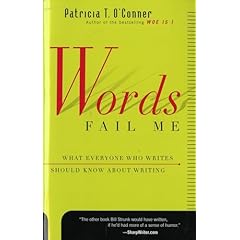
Words Fail Me!

What Everyone Who Writes Should Know about Writing


Well I have been haunted with this idea for quite some time now. I came across this book in Amazon.com. I happen to read it's editorial reviews, felt as though that I have discovered a real gud one!

Here are a few reviews of the book:

  • Patricia T. O'Conner's Words Fail Me is written in the same lighthearted tone as her snappy grammar guide, Woe Is I. This time out, O'Conner tackles the writer's art. "Good writing," she says, "is writing that works." This book is the perfect text for the novice writer who tends to gravitate toward comedic instructors. "Crummy spelling," says O'Conner, "is more noticeable than crummy anything else." Organizing your material "may be a pain in the butt, but it's thankless, too!" "Write as though you were addressing someone whose opinion you value, even if the reader is ... a stingy insurance company that won't pay for your tummy tuck." O'Conner's material isn't new--like many such books, Words Fail Me advocates the use of small words, fresh verbs, and only well-chosen modifiers--but rarely is a primer so amusing. And the clever titles strewn throughout--"Taking Leave of Your Tenses," "The It Parade"--provide added pleasure, particularly for anyone who knows how hard it can be to put a headline on a piece of writing. --Jane Steinberg

  • Patricia O'Conner's Words Fail Me presents so many practical insights into effective writing that I suspect it would be valuable to almost any writer. And there's a bonus: she has a great sense of humor. She debunks the faux pas fallacies that snobbishly tell us how not to write -- don't use contractions, don't start sentences with conjunctions, etc. And she tells us how these supposed `rules' came to be. Wisely, O'Conner's most important rule is this:
  • <>
    "Your first duty to the reader is to make sense. Everything else -- eloquence, beautiful images, catchy phrases, melodic and rhythmic language -- comes later, if at all. I'm all for artistry, but it's better to write something homely and clear than something lovely and unintelligible."
    I read quite a lot, mostly nonfiction (philosophy, reference, science, theology, and wilderness travel). Inevitably, reading compels me to write -- I've submitted more than fifty book reviews to this forum. Yet I'm never quite happy with my writing. This is not unusual. "Your favorite novel or history or memoir is just someone's last revision," says O'Conner.
    As a student I disliked studying the nuts and bolts of English. Words, their accuracy, economy, and artistry, interest me far more now, and this book is the first "how to write" text I have read. At the risk of belaboring the obvious (because good writing doesn't): it was a good choice.
    Highly recommended. - Wesley L Janssen
PS: I would, for sure try to get a copy for myself.

Digg this

Thursday, October 12, 2006

The 2006 winner, The Inheritance of Loss by Kiran Desai


Youngest ever woman wins Man Booker Prize at age of 35

Kiran Desai was tonight (Tuesday 10th October) named the winner of the £50,000 Man Booker Prize for Fiction for The Inheritance of Loss, published by Hamish Hamilton.

The Indian-born writer has a strong family tie with the prize as her mother Anita Desai has been shortlisted three times since 1980 but has never won. This year, however, her daughter, Kiran, has won the acclaimed literary prize.

Author of the 1998 universally praised Hullabaloo in the Guava Orchard, Desai is the first woman to win the Man Booker since 2000 when Margaret Atwood scooped the prize with The Blind Assassin. Her winning book, The Inheritance of Loss, is a radiant, funny and moving family saga and has been described by reviewers as ‘the best, sweetest, most delightful novel’.

This is the first time that Hamish Hamilton has published a Man Booker Prize winner although they had two shortlisted authors in 2005.

Chair of the judges, Hermione Lee, made the announcement at the awards dinner at the Guildhall, London, which was broadcast live on the BBC 10 O’ Clock News. Harvey McGrath, Chairman of Man Group plc, presented Kiran Desai with a cheque for £50,000.

Hermione Lee comments,

“We are delighted to announce that the winner of the Man Booker Prize for 2006 is Kiran Desai’s The Inheritance of Loss, a magnificent novel of humane breadth and wisdom, comic tenderness and powerful political acuteness. The winner was chosen, after a long, passionate and generous debate, from a shortlist of five other strong and original voices.”

Over and above her prize of £50,000, Kiran Desai is guaranteed a huge increase in sales and recognition worldwide. Each of the six shortlisted authors, including the winner, receives £2,500 and a designer-bound edition of their book.

The judging panel for the 2006 Man Booker Prize for Fiction is: Hermione Lee (Chair), biographer, academic and reviewer; Simon Armitage, poet and novelist; Candia McWilliam, award-winning novelist; critic Anthony Quinn; and actor Fiona Shaw.

The Winner

The Inheritance of Loss by Kiran Desai
Hamish Hamilton, £16.99

‘Kiran Desai is a terrific writer. This book richly fulfils the promise of her first.’ - Salman Rushdie

In the north-eastern Himalayas, at the foot of Mount Kanchenjunga, in an isolated and crumbling house, there lives an embittered old judge, who wants nothing more than to retire in peace. But with the arrival of his orphaned granddaughter, Sai, and the son of his chatty cook trying to stay a step ahead of US immigration services, this is far from easy.

When a Nepalese insurgency threatens the blossoming romance between Sai and her handsome tutor, they, too, are forced to consider their colliding interests. The judge must revisit his past, his own journey and his role in this grasping world of conflicting desires - every moment holding out the possibility for hope or betrayal.

Kiran Desai was born in India in 1971, and was educated in India, in England, and the United States. Kiran studied creative writing at Columbia University. She is the author of the critically acclaimed Hullabaloo in the Guava Orchard and The Inheritance of Loss.

More on this: click here...

Digg this

Friday, July 14, 2006

Strange and Unusual Dictonaries


On a complete, whole person.

You see, the problem with this completed person, this O, that both people think they have reached, is that it has taken two people to make this one whole person, one supplying the female energy and one supplying the male. —James Redfield, The Celestine Prophecy.>

Testimonials:

One of the Web's best sites!" —Encyclopedia Britannica Online

Recommended by John Walkenbach, author of Excel 2003 Bible

"ALL LITERATE PEOPLE (hint, that includes you) need the Strange and Unusual Dictionaries" —Clark Humphrey, author of Loser: The Real Seattle Music Story

"Why not take a look at Conley's One-Letter Words Dictionary? It's crazy and useful. Isn't that what we all aspire to?" —Matt Getty, author of You Will Behave


"I'm a smart guy, but I must confess that I could not have come up with thirty-four definitions for the letter G. So thank goodness for Craig Conley, the ultimate man of letters. His 230-page joyride through the English alphabet reads like a Scrabble dictionary on steroids. Giving due deference to every building block of our language, Conley does for letters what James Merrill's Body did for words. This book provides for fascinating reading from A (To not know "A from B" is to be ignorant) to Z (A hypothetical explosive, more powerful than an A or H bomb).
—Dave C., Harvard Book Store

Find them here:
http://www.blueray.com/dictionary/


Digg this

Lateral thinking

There is a man who lives on the top floor of a very tall building. Everyday he gets the elevator down to the ground floor to leave the building to go to work. Upon returning from work though, he can only travel half way up in the lift and has to walk the rest of the way unless it's raining!An interesting quiz for ur Lateral Thinking abilities --- Think !

Why? (This is probably the best known and most celebrated of all lateral thinking puzzles. It is a true classic. Although there are many possible solutions which fit the initial conditions, only the canonical answer is truly satisfying. )

....

....

....


SOLUTION

The man is very, very short and can only reach halfway up the elevator buttons. However,if it is raining then he will have his umbrella with him and can press the higher buttons with it.

Find more on lateral thinking at:

http://www.edwdebono.com/debono/lateral.htm


Digg this

Thursday, July 13, 2006

Art of Making Enemies !!!

Well i am not here in to starting a tutorial on the above. This was something i read a few days back. It really fascinated me, and put me in to some serious thinking. I wondered if anybody could have ever made an attempt to write something like this.

The book was actually published in 1890 !!!! now thats quite a long time u know. The article i read mentioned that the original author's name was not published, but if we go by the words of publisher, the author who penned down such a work was whisler, I guess even before the book was published the author had managed to make good number of enemies (including the publisher)

The book titled "The Gentle Art Of Making Enemies", could be found at Blossoms, church street, Bangalore.. (080-25320400) (as per the article).. so if u happen to give a visit try this one..

Also u could read, "How to win friends and influence people", by Dale Carnegie

Last Punch: In todays world of cut-throat competition u always have enemies around you, so u don't need to make any "special efforts".

Digg this